
Equity Impact vs Equity Intentionality | 002 | Equity Strategy
Why we need both. The unproductive fight is hurting students.

Note: If I had a dollar for every time I’ve been called in after a college was derailed by an unproductive equity debate, I’d have my own endowment. I wrote a piece about this challenge, and after finishing it, I found myself scribbling some reflection notes, in the margins...or maybe at a bar...talking to close friends and colleagues in the work, especially given the attacks on equity work by this current federal administration.
This is that version.
First, Let’s Get Something Straight
You can’t talk about equity in higher ed without pissing someone off. You either:
Aren’t radical enough
Are too radical
Or “sold out” by saying something actually useful to practitioners
Meanwhile, students of color are still being underserved at too many campuses.
I’ve been coaching institutions for two decades. Most of them community colleges and broad-access institutions. I’ve seen it all. And here’s what’s disappointing: the false binary between two camps that should be on the same damn team.
This unproductive rivalry is exactly what the few who thrive on toxicity want. They pit groups against each other to protect the status quo because nothing guarantees zero meaningful change like a campus culture stuck in dysfunction.
The Two Camps
Camp A: Equity Intentionality Only
This camp argues that anything “race-neutral” is inherently bad for students of color. They believe the only meaningful approach is to explicitly name and address racial equity at every turn, even if that means rejecting broad, data-backed reforms like developmental education reform, a cornerstone of Guided Pathways.
Their rhetoric? Often strong. Their implementation? Rarely clear. And too often, they alienate the very educators we most need to influence.
Camp B: Equity Impact Only
This camp backs universal reforms. Things like developmental ed reform, Guided Pathways, onboarding redesigns. Their argument? Focus on systems only. Reach more students. Let the scale do the work.
But here’s the problem:
They often skip race-specific approaches, believing that universal fixes will close gaps on their own. (Spoiler: they won’t always, and not entirely.)
Both Camps Are Right
Here’s what years of deep, on-the-ground work—and a proven track record of improving equitable outcomes—make clear:
We need both.
Yes, universal approaches, when implemented well at institutions that serve the greatest number of disproportionately impacted students, leads to real equity impact. Students of color are completing English and math at higher rates than ever. Transfer rates are climbing at institutions that actually turn broad strategy into action. Excess units are dropping at these institutions. Texas community colleges like Alamo comes to mind. It works.
But yes, equity gaps often remain. You don’t solve for racial equity just by only improving systems at large. You still need intentionality: culturally responsive pedagogy, meaningful faculty development, and leadership (this includes faculty) that doesn’t run scared when politics get messy.
The Sabotage Is Real
You want to know what doesn’t work?
Conducting webinars that call Guided Pathways a “deficit mindedness frame that focuses on what racially minoritized student lack.” That’s a straight up lie.
Publishing reports based on word count analyses of compliance docs and calling it "research" when it’s really gross assumptions about college educator racial equity discourse.
Charging $95,000 for three racial equity workshops and six hours of technical assistance where faculty walk away more entrenched and less willing to grow in the equity work.
I’ve been called in to clean up the mess. Especially when educators of color, many of whom are leading the work on the ground, call me in quietly to say:
“That racial equity webinar set us back. We were making progress.”
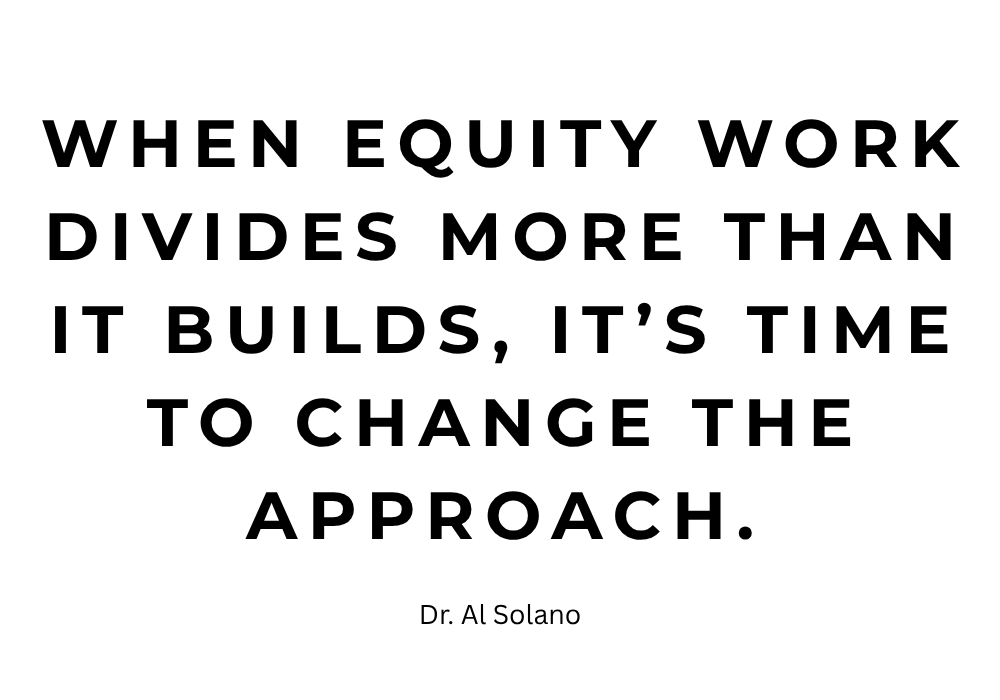
What Equity Intentionality Should Look Like
Equity intentionality isn’t about scolding white faculty, especially at community colleges and broad-access institutions serving the most disproportionately impacted students. You can’t insult away someone’s decades worth of racial conditioning. And when racial equity scholars ignore or dismiss fields like organizational behavior theory or teaching & learning theory, they risk advancing a narrow, ineffective approach that ultimately undercuts the very equity they claim to champion. It’s about:
Providing the context, tools, and coaching that actually change practice.
Acknowledging the racialized outcomes and equipping people to teach more effectively.
Meeting people where they are, and moving them. Kindness matters.
Calling people in, not just out. Bring them in to do the work. Attitudes and behaviors change over time through productive work.
Look, I’m saying not white supremacy isn’t real. It’s real. But effectively yelling at college practitioners?
That’s not strategy. That’s performance.
So... What Now?
We need to stop treating equity impact and equity intentionality like opposing forces. They’re not enemies. They’re co-conspirators in the same fight, when implemented well.
I often hear, “We already tried the all-students approach for decades.”
My response? “No, we didn’t. Not really.”
For decades, “all students” really meant white students because that’s the majority of students open and broad-access institutions served. It was business as usual. But demographics have shifted (it’s what helps to fuel MAGA), and today, there are a multitude of majority “minority-serving” institutions, and growing. It wasn’t until about ten years ago that developmental ed reform and the Guided Pathways movement—at colleges serving the most disproportionately impacted students, including students of color—that we finally started applying a universal approach grounded in continuous improvement. That’s the difference. Inspired by Redesigning America’s Community Colleges, for once, campuses began trying to get their shit together on purpose en masse.
That’s not the same as business as usual. That’s a shift. And it matters.
That means:
Stop sabotaging student journey and continuous improvement frameworks such as Guided Pathways and developmental ed reform because it doesn’t “sound” radical enough. Trashing the book Redesigning America’s Community Colleges at speaking engagements is not only tired, it’s spectacularly counterproductive.
Stop pretending closing a gap to 30% success for everyone is good enough.
Reconsider highly expensive consultants, speakers, and university theorists who are better at clapbacks than helping you with real implementation. Some do this work with heart and offer practical, nuts-and-bolts tools. Seek those out.
And above all, stop confusing misinformed opinions with strategy.
The real enemy isn’t the other camp.
The real enemy is confusion, ego, and inertia.
And the students are the ones paying the price.
Let’s do better. Let’s do both. We can’t continue with this unproductive rivalry, especially when the current federal administration is out to end all equity work.
Equity impact and equity intentionality.
As I’ve often said,
“Institutions achieve student success when college educators help each other succeed.”
Onward…
Dr. Al Solano
Founder, Continuous Learning Institute | About
Host, Student Success Podcast
A meaningful test of success is how helpful we are in contributing to our fellow human being’s happiness.