
Learning That Matters | 019 | From Struggle to Student Success
What happens when educators have the time, process, and support to improve.

How do you bring a group of faculty together in such a way that, by persisting through productive struggle, they collaborate to improve their craft, and in doing so, raise student success and even close equity gaps?
It’s a hard question. But it’s the right one. And I have an answer.
First, consider what UCLA emeritus professor Ron Gallimore, co-author of Rousing Minds to Life, concluded after many years of research:
If institutions are to be productive places of learning for students, they must also be productive places of learning for educators (paraphrased). It’s a simple premise, but incredibly hard to pull off in higher education.
The truth is, education systems are not built for their professionals to learn. Yes, there are professional development sessions, but often they’re an hour or two here, a breakout there, and rarely structured for real growth. Teaching is a rewarding profession, but it’s also one of the hardest to do well. Faculty deserve more than surface-level PD. They deserve meaningful opportunities to continually improve their craft.
And here’s the part that makes some uncomfortable: real learning is messy. Most faculty aren’t used to being in “the learning space” themselves. It’s vulnerable. It’s disorienting. But it’s also where the magic happens, if the right support and structure are in place.
As this Duke professor explains in the short clip below, being in the learning space (I like to call it “productive struggle”) can be hard, but it’s different when you're not doing it alone.
Source (Instagram Video)
We ask students to be in the “learning space,” but it’s just as critical for faculty to be in this space as well to continually improve as teaching and learning professionals. So… what does it take?
Let’s take a look at my latest case study, Ventura College. We didn’t answer this question with theory. We answered it with action.
Guided by my Inquiry & Action model (featured by Columbia University’s Community College Research Center), the English department launched three faculty teams. Each group picked a focus area, studied their own teaching practices, implemented what I like to call “treatments,” and examined their results. All in one year.
It wasn’t easy. It was productive struggle in real time. But the results were undeniable:
Success and retention rates jumped.
Equity gaps narrowed and some cases closed, especially for Hispanic and female students.
Faculty designed instructional plans using the 5E framework, improved hybrid instruction, and sharpened writing pedagogy using a collaborative, action-driven approach. They implemented well thought-out and planned “treatments,” then compared student outcomes to the previous semester.
For example, one team achieved the following.
• Success Rate: 54.3% → 76.9%
• Retention Rate: 85.2% → 94.2%
• Hispanic Success: 51% → 75%
• Hispanic Retention: 84% → 94%
• Female Success: 55% → 78%
• Female Retention: 88% → 94%
These were real results, in real classrooms, from faculty doing the hard work of learning together.
The 6-Step Process
This work is grounded in a straightforward, six-step process I developed and coach on to guide teams. A form of Plan-Do-Check-Act, it’s highly detailed process.
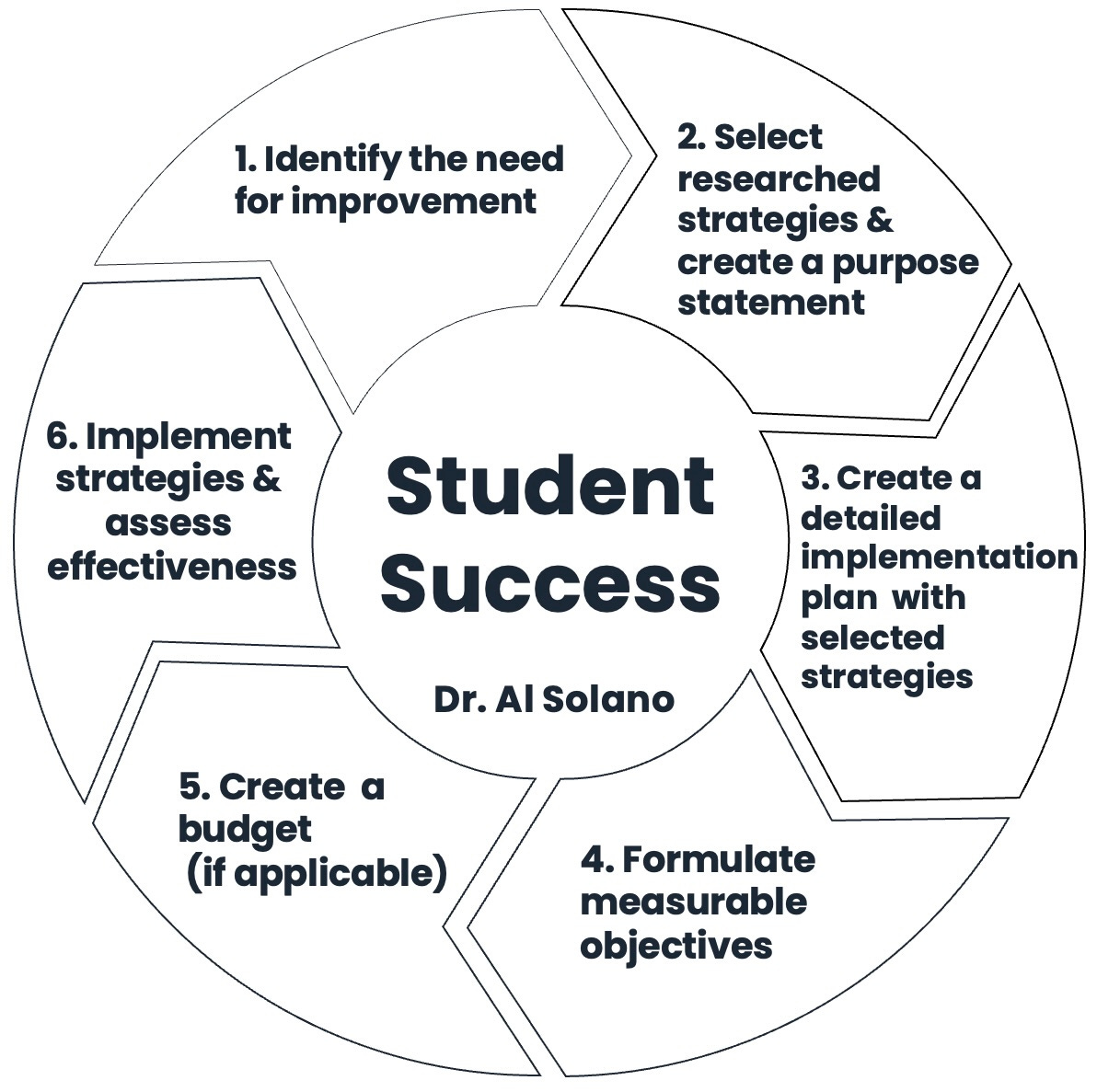
The steps may sound like a no-brainer. But the productive struggle is real. And it works. When completed, the 6-Step inquiry & action process workbook can be 30-50 pages long; filled with some of the most exciting and meaningful faculty-driven work in higher education.
What Makes This Work…Work
Three primary ingredients gets results.
1. Settings
Faculty need dedicated time and space to do this work. You can’t squeeze reflective, collaborative practice into a 45-minute lunch break. Faculty meet for two one-and-half hour meetings per month, and for those who are available, we continue a modicum of work during the summer to maintain momentum. Each team has a faculty lead, and the leads also become a team.
2. A Process
Improvement doesn’t happen through vibes or good intentions. It requires a structure that balances inquiry, action, and results.
Even the most committed faculty need a partner in the work. Someone to help them navigate complexity, stay focused, and keep the work moving forward.
At Ventura, all three elements were in place. Faculty had protected time, a proven process, and structured support. The result? Measurable gains in success, retention, and equity. Yes, there’s often a financial cost. It varies by campus with their stipend structure or ability to give faculty PD hours and/or committee service as options. The benefits in student retention and success outweigh the cost.
Final Thought
When faculty are treated as professionals by providing them with time, structure, coaching, and the chance to learn in community, they get better. And when they get better, so do student outcomes.
The goal isn't dependency on an external coach. The goal is capacity. Ventura educators help others use the process. Also, they’ve adapted the Inquiry & Action model and tools to implement the student equity plan and better integrate the Guided Pathways work.
Want to know what professional learning looks like when it actually works?
This is it.
» Read the Columbia University CCRC feature.
» See the Ventura College case study.
» Learn the inquiry & action experience at Santa Barbara City College, Irvine Valley College, and Miramar College.
Ask yourself: What would this look like on your campus?
Let’s connect on LinkedIn
Onward…
Dr. Al Solano
Founder, Continuous Learning Institute | About
Host, Student Success Podcast
A meaningful test of success is how helpful we are in contributing to our fellow human being’s happiness.