
Online Teaching & Learning | 015 | Humanize the Experience
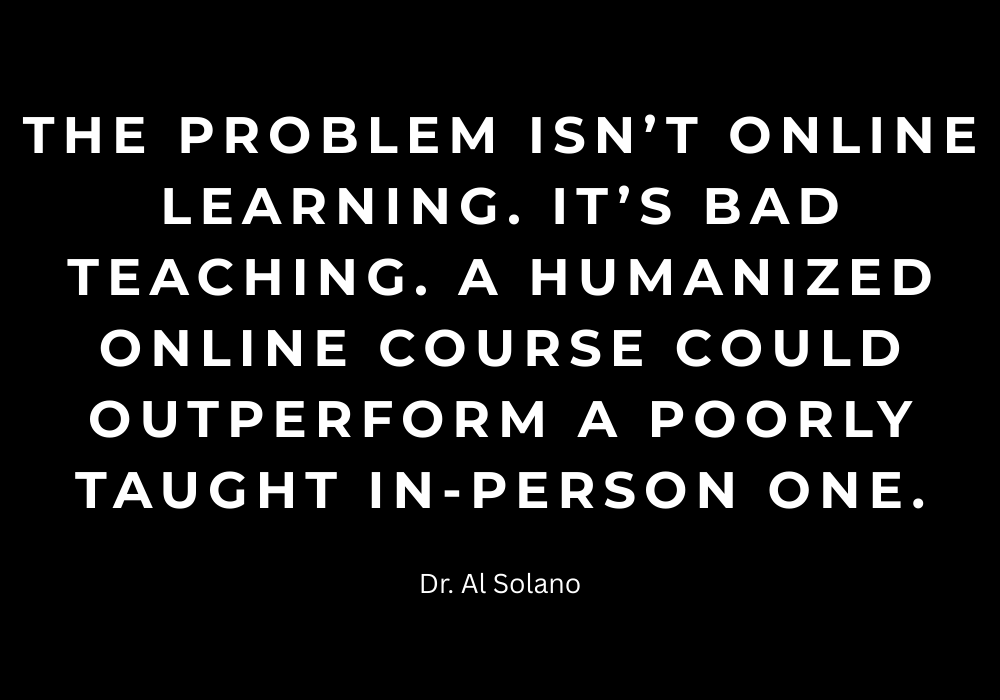
Effective online learning isn’t accidental.

Sometimes one sharp insight is all we need to hold on, reset, or reengage with purpose.
Practical takeaways pulled from the Student Success Podcast, so you don’t have to listen to the whole episode (unless you want to).
Episode with faculty, Maritez Apigo: Show Notes | Apple | Spotify
What does it really take to create an engaging online course, especially for working students and student parents? I spoke with Maritez Apigo, veteran educator and Distance Education Coordinator at Contra Costa College. With over two decades of teaching experience, a DJ’s instinct for sequencing, and a fierce commitment to student success, Maritez broke down how to humanize online education without lowering academic standards.
Below are six key takeaways, with action steps you can implement today, to design online learning environments that are affirming and effective.

1. Humanize Before the Class Even Starts
Online doesn’t have to mean distant. Presence starts before day one.
Action Step:
Send a “welcome package” that includes:
A warm introduction video
A mobile-friendly liquid syllabus (more on that below)
Clear, friendly course policies that emphasize flexibility and support over punishment
Swap “NO LATE WORK ACCEPTED!!!” for “Let’s make a plan if you need more time.”
2. Know Who Your Students Are, and Teach Accordingly
Equity requires context. It’s hard to design relevant learning experiences if you don’t know your students’ lives.
Action Step:
In Week 1, have students complete a survey asking:
Are you a parent?
Do you work full-time?
Is English your second language?
Use this information to tailor support, deadlines, and communication.
3. Be Present, Responsive, and Consistent
Maritez’s research, and common sense, tells us students succeed when they feel their instructor is present and rooting for them.
Action Step:
Send weekly video announcements (recaps, previews, feedback, shoutouts).
Offer flexible “office hours” rebranded as Writing Conferences or Help Sessions with extra credit incentives.
Respond to student messages within 24–48 hours. Students can’t move forward if they’re waiting on answers.
4. Build Community Through Student-to-Student Interaction
Don’t rely on clunky “post once, reply twice” discussion boards. That’s not community. That’s compliance.
Action Step:
Use small group discussions instead of whole-class forums.
Try apps to encourage peer-to-peer video responses.
Incorporate peer review and low-stakes group projects, even online.
Remember: Learning happens between students too, not just between student and content.
5. Design with Clarity and Structure
Students repeatedly say they want online classes that are clear, organized, and predictable. Disorganized courses erode equity.
Action Step:
Use consistent weekly modules in Canvas or your LMS.
Provide detailed assignment instructions and examples.
Align all content with your weekly video to reinforce direction and expectations.
6. Reimagine Grading and Rethink “Real World” Rhetoric
Flexible deadlines and alternative assignments aren’t lowering standards—they’re removing unnecessary barriers.
Action Step:
Stop assuming every missed deadline is irresponsibility.
Incorporate ungrading principles: prioritize feedback over points.
Use authentic assessments tied to student interests and lived experiences.
As Maritez puts it: “If it’s the difference between success or failure, I’ll give the student an extra week.” That’s not leniency, that’s equity in action.
Bonus Tool
Liquid Syllabus: A mobile-friendly, accessible webpage version of your syllabus with embedded videos and welcoming language.
Final Thought
Equitable online learning doesn’t happen by accident. It’s the result of intention, presence, and a deep belief that every student can succeed with the right support.
As one student told Maritez:
You can tell which teachers want you to succeed.
Let’s be those teachers.
Let’s connect on LinkedIn.
Onward…
Dr. Al Solano
Founder, Continuous Learning Institute | About
Host, Student Success Podcast
A meaningful test of success is how helpful we are in contributing to our fellow human being’s happiness.