Workgroups That Work | 052 | Avoiding Organic Drift
Structure creates clarity. Clarity creates progress.

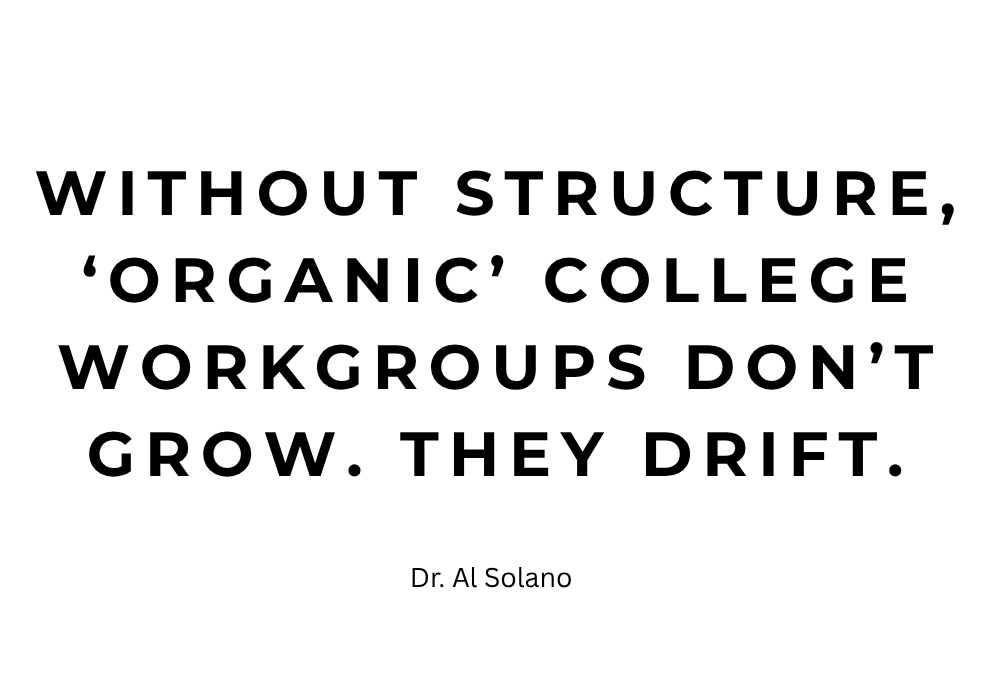
“Organic processes are fine, but without some measure of structure and guidance, college workgroups inevitably become organically lost.” – Dr. Al Solano
Enhance your professional development. Subscription upgrade available.
The Appeal of “Organic” Work
Many college teams value flexibility, open dialogue, and shared ownership, and rightfully so.
Organic processes can:
Create space for creativity
Strengthen relationships
Encourage broader participation
That’s important work. But let’s be clear:
Organic doesn’t mean aimless.
Without clarity, even the most well-intentioned teams drift.
Why Structure and Guidance Matter
Structure doesn’t have to mean rigidity.
It means:
A clear purpose
Defined roles
Agreed-upon deliverables
Realistic timelines
It means knowing:
What success looks like
How decisions will be made
How progress will be tracked
Guidance can come from:
A facilitator
A co-chair
A well-designed agenda
Without these anchors, conversations become circular. Energy dissipates. And fatigue sets in.
The Risk of Organic Drift
When teams operate without structure, a pattern emerges:
Meetings feel repetitive
Participation drops
Deadlines slide
Momentum fades
Eventually, people begin to wonder: “Is anything actually going to change?”
That’s when a team becomes:
Organically lost.
Still meeting. Still talking. But not moving.
And when this stretches beyond a couple of months, it runs directly into what I call the Three-Month Rule.
If meaningful progress isn’t happening within that window, the likelihood of sustained execution drops significantly.
A Common Pattern I See
When a new initiative launches or an existing one is refreshed, colleges form teams.
Sometimes they call them “committees.” I prefer workgroups because the keyword is work.
Committees are often where ideas go to die. Workgroups are where ideas are supposed to move.
But here’s what happens far too often:
Teams want the process to feel inclusive, collaborative, and “organic.” So they avoid structure. They take a “let’s wing it” approach.
The intention is good:
Everyone will contribute
Everyone will feel ownership
But without structure, something else happens:
No one is steering.
And after two or more semesters, I’m sometimes brought in because the team has had a realization: “We’ve been meeting for a while… but we haven’t really moved anything.”
They’ve become organically lost.
How to Be Organic But Not Aimless
You don’t need a complicated system. Just discipline around a few fundamentals.
1. Start with a Clear Purpose
Every workgroup should develop a purpose statement.
It usually starts with:
“To…”
This anchors the work. It ensures everyone is aligned from the beginning.
Tip:
Don’t spend more than two meetings on this. Clarity matters, but so does momentum.
2. Schedule Consistently (and Ahead of Time)
Calendar:
At least two one-hour meetings per month
And don’t wait until the new semester to figure it out.
Schedule meetings before the current term ends. Consistency builds rhythm. Rhythm builds progress.
3. Always Have an Agenda with an Outcome
This is huge.
Every meeting should include:
An agenda
A clear intended outcome
Even better:
Use the last 10 minutes to gather input for the next agenda
And please:
Include all links, documents, and materials in the calendar invite. I’ve lost count of how many teams spend the first 10–15 minutes searching for things that should have been there from the start.
4. Designate a Facilitator
Someone needs to guide the work.
That could be:
A consistent facilitator
A rotating role
But whoever it is must have the license to say: “We’re drifting. Let’s come back to the agenda.”
That’s not control. That’s respect for people’s time and the work.
Final Thought
These tips are not groundbreaking.
But they work. And sometimes excellence isn’t about innovation. It’s about doing the ordinary extraordinarily well.
Organic processes create space. Structure creates direction. You need both.
Without structure, even the best intentions don’t translate into results. And when educators don’t move the work forward together, students feel the impact.
If your institution needs support planning and/or implementing priorities, contact me. I’ll help you be successful.
Let’s connect on LinkedIn.
Onward…
Dr. Al Solano
Founder, Continuous Learning Institute | About
Host, Student Success Podcast
A meaningful test of success is how helpful we are in contributing to our fellow human being’s happiness.
Depending on your college’s professional development policies, you may be reimbursed for the Continuous Learner premium subscription.
Use this template to request a reimbursement.