
Addressing Cognitive Offloading | 57 | Teaching & Learning
A pedagogical framework for faculty incorporating A.I. in the classroom.

A recent article on strategic cognitive offloading in teaching and learning names the problem. The 5E Learning Cycle addresses it.
I came across Dr. Tawnya Means’ piece on strategic cognitive offloading, and something clicked.1 Dr. Means draws on a 2026 study by Wang and Zhang identifying three zones of A.I. use in learning.2
Three Zones for A.I. Use in Learning
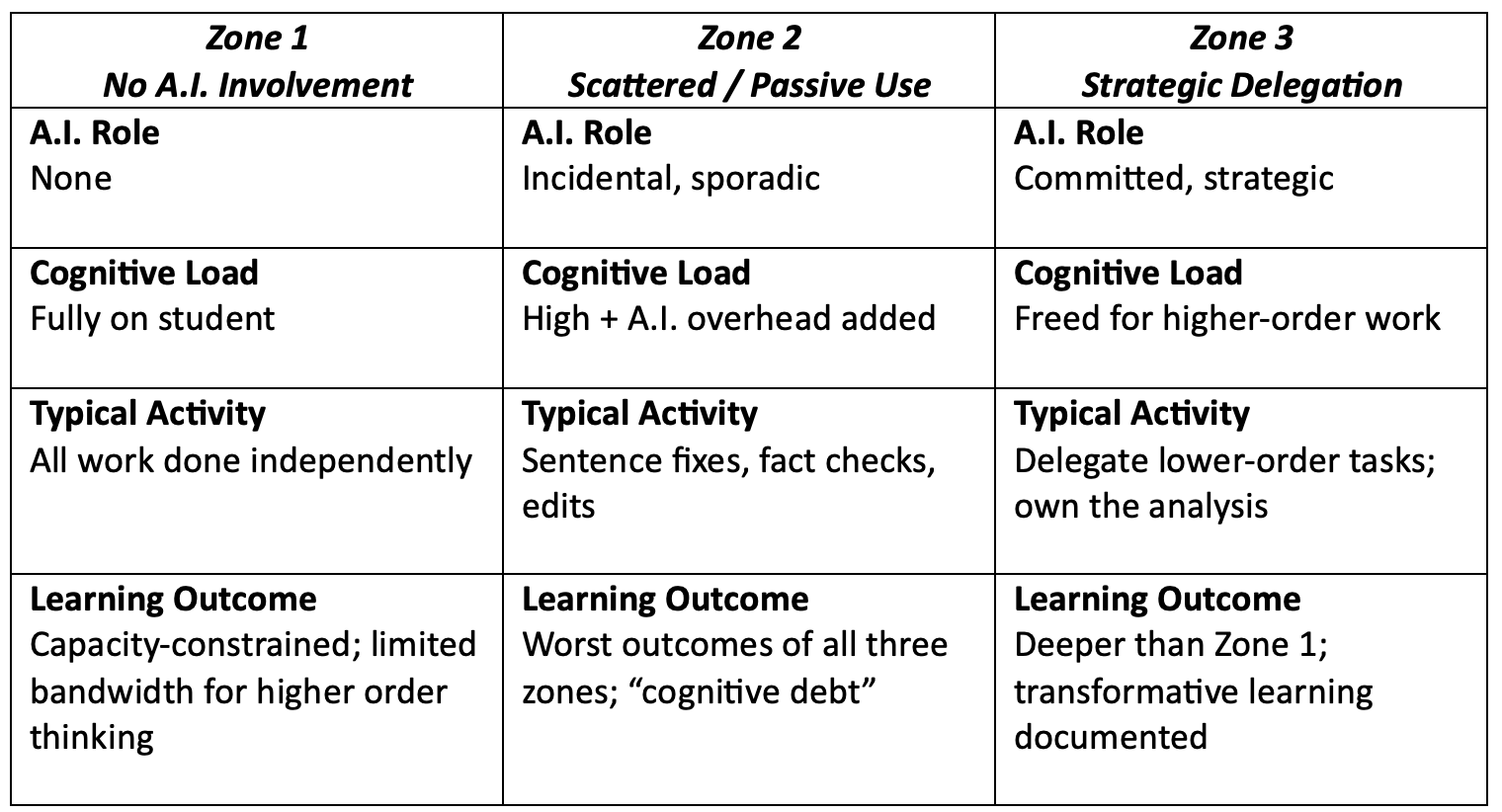
Zone 1 is no A.I. at all: students carry the full cognitive load. Zone 2 is scattered, half-hearted use: fixing sentences, tidying paragraphs, checking facts. Zone 3 is committed, strategic delegation: offloading select categories of lower-order work to A.I. so that genuine cognitive capacity gets freed and students can focus on critiquing frameworks, questioning assumptions, constructing original arguments, making judgment calls.
Zone 3 is where transformative learning lives. And as Dr. Means points out, Zone 2 is where most student A.I. use currently sits, producing the worst learning outcomes.
Here is what she writes near the end:
“The structural problem is that most faculty were not trained to design for Zone 3, most current assessment structures make it invisible when students land there, and most students have not been taught what strategic delegation requires or why it matters. Those are not insurmountable problems. They are pedagogical problems, which means they yield to pedagogical solutions.”
I’ve been working with one of those pedagogical solutions for about two decades. It’s called the 5E Learning Cycle.3 And when I read Dr. Means’ article, I saw the entire framework, every phase of it, map directly onto the conditions that Zone 3 requires.
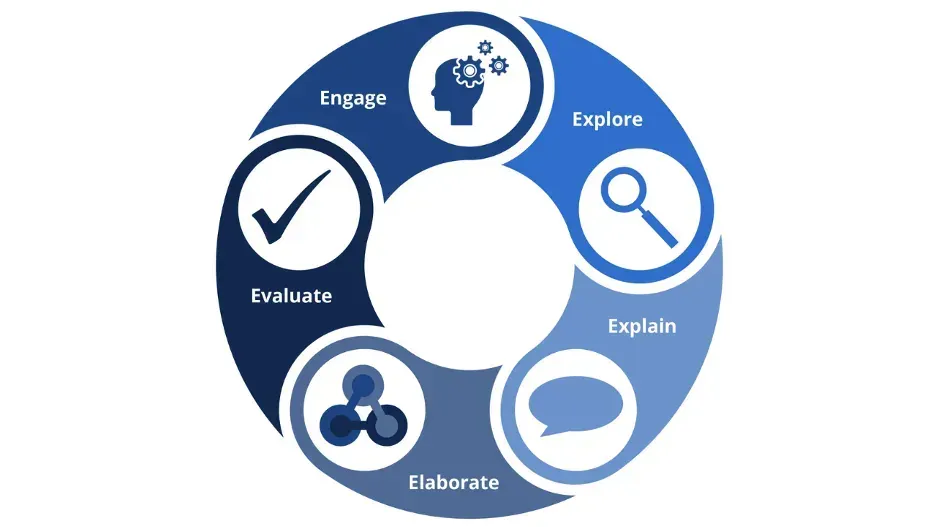
What the 5Es Do That Zone 3 Needs
The 5E Learning Cycle—Engage, Explore, Explain, Elaborate, Evaluate—isn’t a new idea. It was developed decades ago, and I’ve been coaching educators on it long enough to know both its staying power and its persistent underuse in higher education. But it’s worth looking at it fresh through the lens of cognitive offloading, because the fit is not superficial. Below are suggestions to experiment with, and you don’t have to use A.I. for each phase, unless you want to.
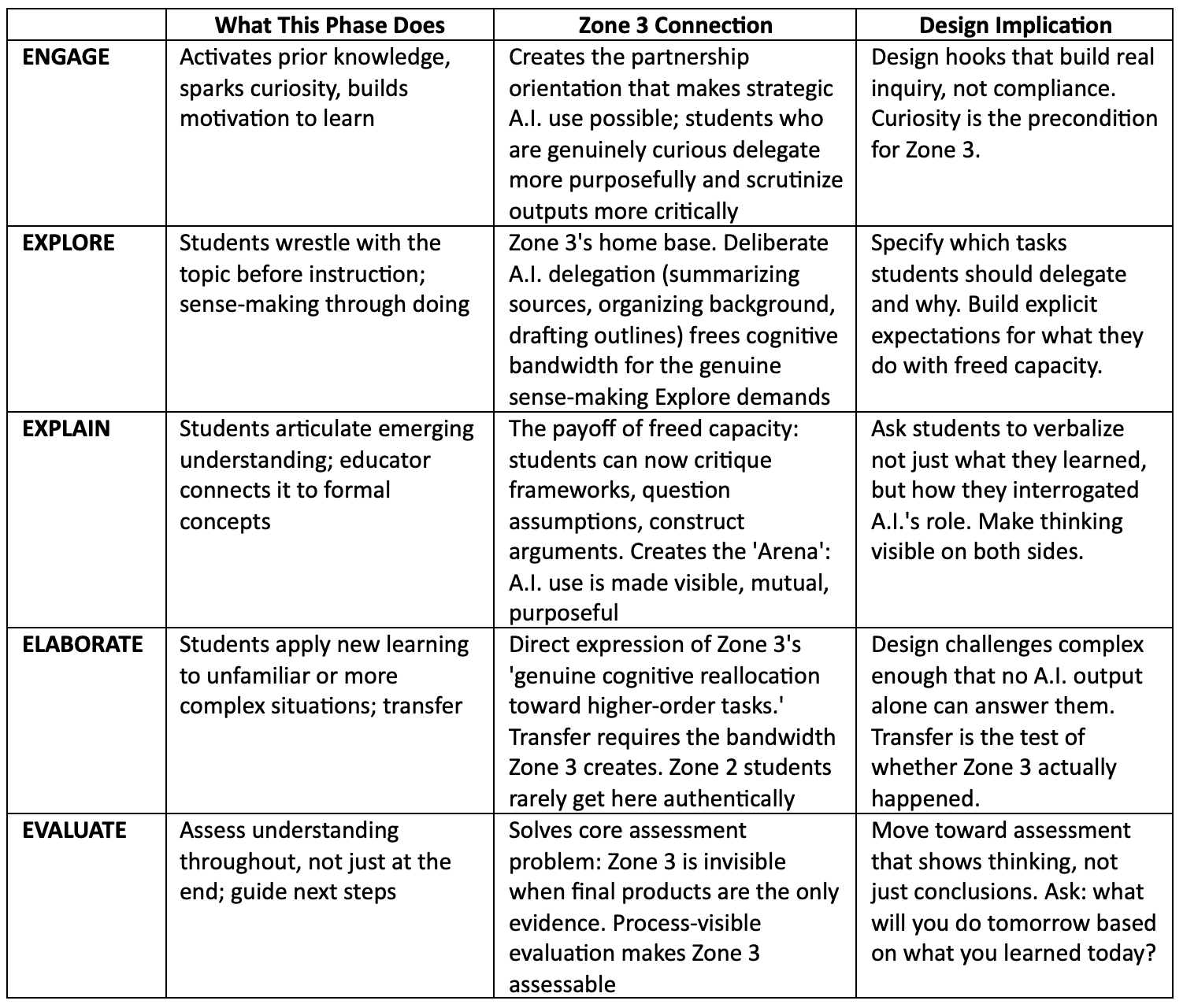
Engage is where Zone 3 begins, even before A.I. enters the picture. The Engage phase activates prior knowledge, sparks curiosity, and gives students a reason to care about what comes next. This is the motivational precondition for strategic A.I. use rather than lazy A.I. use. Students who arrive at a task with genuine curiosity ask better questions of A.I. tools. They push back on outputs that don’t fit. They notice when something is off. Dr Means describes Zone 3 students as having a “partnership orientation” with A.I. Students simultaneously delegate more and scrutinize more. That orientation doesn’t emerge from compliance. It emerges from engagement.
Explore is where Zone 3 lives most naturally. This is the “let them wrestle” phase. It’s the structured opportunity to experiment, observe, and make sense of something before anyone tells them what it is. This is precisely the phase where deliberate A.I. delegation could pay off: offloading source summarization, organizing background material, generating a first-pass outline, so that students can concentrate their cognitive effort on the sense-making that the Explore phase demands. The whole point of Explore is to free up attention for genuine inquiry. Strategic A.I. use is a mechanism that can help make that possible. Without it, students burn bandwidth on execution and have less left over for the thinking that actually matters.
Explain is where the freed cognitive capacity pays out. Once students have explored, the Explain phase invites them to articulate what they’ve constructed. They put language to emerging understanding and connect their experience to formal concepts and vocabulary. This is the “critiquing frameworks, questioning assumptions, constructing original arguments” that Dr. Means describes as the irreducible human work Zone 3 requires. Notably, Dr. Means’ Johari Window section identifies the Arena, where both educator and student have shared visibility into how A.I. is being used and why, as the quadrant where real learning gains occur. The Explain phase, done well, creates Arena conditions: understanding is made visible, on both sides, through conversation rather than performance.
Elaborate maps directly onto what Dr. Means calls “genuine cognitive reallocation toward higher-order tasks.” The Elaborate phase pushes students to apply what they’ve learned to new situations: unfamiliar problems, interdisciplinary contexts, real-world scenarios that don’t look exactly like the lesson. This is transfer, and transfer is exactly what Zone 3 is supposed to enable. Students who have delegated lower-order work and invested the freed capacity in understanding are positioned to do the harder thing: take that understanding somewhere new. Zone 2 students, who never really freed that capacity, tend to get stuck at the surface.
Evaluate is where the design problem Dr. Means identifies becomes most urgent, and where the 5Es offer a direct answer. Dr. Means argues that most current assessment structures make Zone 3 invisible because they reward final products over learning processes. Her recommendation is to move toward portfolio-based assessment, oral components, A.I. conversation transcripts, process documentation. In other words, anything that makes the thinking assessable rather than just the output. The 5E Evaluate phase was built on exactly this premise: evaluation isn’t just for grading, it’s for guiding, and it happens throughout a lesson rather than only at the end. The reflection prompts I use: How will they demonstrate learning in authentic, relevant ways? What will you do tomorrow based on what you learn today? It points away from the polished-product model and toward the process visibility that Zone 3 requires.
The 5E Learning Cycle & Zone 3: Where They Meet
5E Model (Solano, 2025) aligned with Strategic Cognitive Offloading (Wang & Zhang, 2026)
Resources: The 5Es in STEM teaching & learning | The 5Es in Social Sciences & Humanities teaching & learning | Faculty Learning That Works
The Design Problem Nobody Really Assigned to Faculty
Dr. Means pointed about where higher education has fallen short: “Faculty are trained as disciplinary experts. Most doctoral programs don’t address instructional design, cognitive load theory, or assessment construction in any serious way.” She’s right. The assumption embedded in the traditional model is that content expertise, combined with reasonable lecture and assessment structures, produces learning. The pedagogical questions, which cognitive tasks should students own versus delegate, how to scaffold the transition, how to make that process visible, were not really formally assigned in graduate studies.
This is why the 5E model matters beyond its individual phases. It gives faculty an opportunity for structured experimentation and for making pedagogical decisions that most were never taught to make. It’s not a checklist. It’s a framework for thinking and experimenting about where learning lives, and who’s doing the work of constructing it, at every stage. When I’ve coached faculty through it, including a group at Ventura College who saw significant gains in student success and closed equity gaps, the transformation isn’t usually about adopting new activities. It’s about shifting orientation: from “what will I lecture?” to “what will students construct?”
That shift is exactly the shift Zone 3 requires.
What This Means for Your Course Design
If you’re a faculty member thinking about A.I. integration, here’s the practical read:
An assignment that says “you may use A.I.” without specifying what, how, and to what pedagogical end will more than likely produces Zone 2, as Dr. Means notes, the zone with the highest cognitive overhead and the worst learning outcomes. Zone 3 requires deliberate design.
The 5E framework gives you a template for that design and experimentation. Adjust your instruction accordingly. Plan, implement, analyze, and iterate.
In Engage, be intentional about building the genuine curiosity and partnership orientation that makes strategic A.I. use possible.
In Explore, specify which cognitive tasks students should delegate to A.I. and why, and build in explicit expectations for what they’ll do with the freed capacity.
In Explain, create Arena conditions: make A.I. use visible, purposeful, and connected to the learning objective. Ask students to verbalize not just what they learned, but how they interrogated the A.I.’s role in getting them there.
In Elaborate, design for transfer, and design challenges complex and engaging enough that no A.I. output alone can answer them and that inspire students to tackle on their own.
In Evaluate, move toward process-visible assessment. Ask students to show their thinking, not just their conclusions.
This isn’t more work. It’s clearer work. And it puts learning where it belongs: in the hands of students.
The Framework We Already Have
Dr. Means ends her piece with this: “The research now exists to tell us what good A.I.-integrated learning looks like. The work ahead is building institutions that can act on it.”
I’d push that slightly: the pedagogical frameworks to act on it already exist too. From my experience, the 5E Learning Cycle has been producing documented learning gains for decades. It is, by design, a framework for Zone 3 for sequencing student experience so that cognitive effort concentrates where it matters most, and so that understanding is constructed rather than consumed.
The question isn’t whether we have what we need. It’s whether we’ll actually use it. Design and learn with the 5Es.
Faculty can experiment with the 5Es so that students still do the thinking that matters. I don’t claim to have the silver bullet here. We’re all figuring this out together. I hope you find this resource helpful. I look forward to learning from faculty who use the 5Es for strategic A.I. integration.
And if you’re conducting professional learning for faculty navigating A.I. in the classroom, use this cycle there, too. Adults need time to explore before they’re expected to buy in.
Let’s connect on LinkedIn.
Onward…
Dr. Al Solano
Founder, Continuous Learning Institute | About
Host, Student Success Podcast
A meaningful test of success is how helpful we are in contributing to our fellow human being’s happiness.
Enhance your professional development. Subscription upgrade available.
Depending on your college’s professional development policies, you may be reimbursed for the Continuous Learner premium subscription.
Use this template to request a reimbursement.
The original article by Tawnya Means, “Strategic Cognitive Offloading: What the Research Says, and Why Higher Education Isn’t Ready for It,” appeared in her Substack, The Collaboration Chronicle on April 20, 2026.
Wang, S., Zhang, H. Pedagogical partnerships with generative AI in higher education: how dual cognitive pathways paradoxically enable transformative learning. Int J Educ Technol High Educ 23, 11 (2026). https://doi.org/10.1186/s41239-026-00585-x
Solano, A. (2025). The 5E learning cycle: Practical pedagogy. Continuous Learner, Issue 012. Continuous Learning Institute. https://alsolano.substack.com/p/the-5e-learning-cycle-012-practical
Thanks for the inspiration, @tawnyameans