
Create Common Language | 043 | Institutional Planning
Learn to create clarity, coherence, and consensus in institutional planning.

Sometimes the biggest barrier to progress isn’t always resistance, funding, or capacity. It’s vocabulary. A lack of clarity.
Institutions of higher education routinely invest months, sometimes years, into all manner of plans with language that is unclear and inconsistent.
As I’ve seen repeatedly across campuses, the same term can mean different things in different plans: objective in one document, strategy in another, something else entirely in a grant proposal. The result is confusion, misalignment, and stalled execution.
Institutions of higher education need to create common language. Clarity is not a formatting issue. It’s an implementation strategy for plans. Consider the following.1
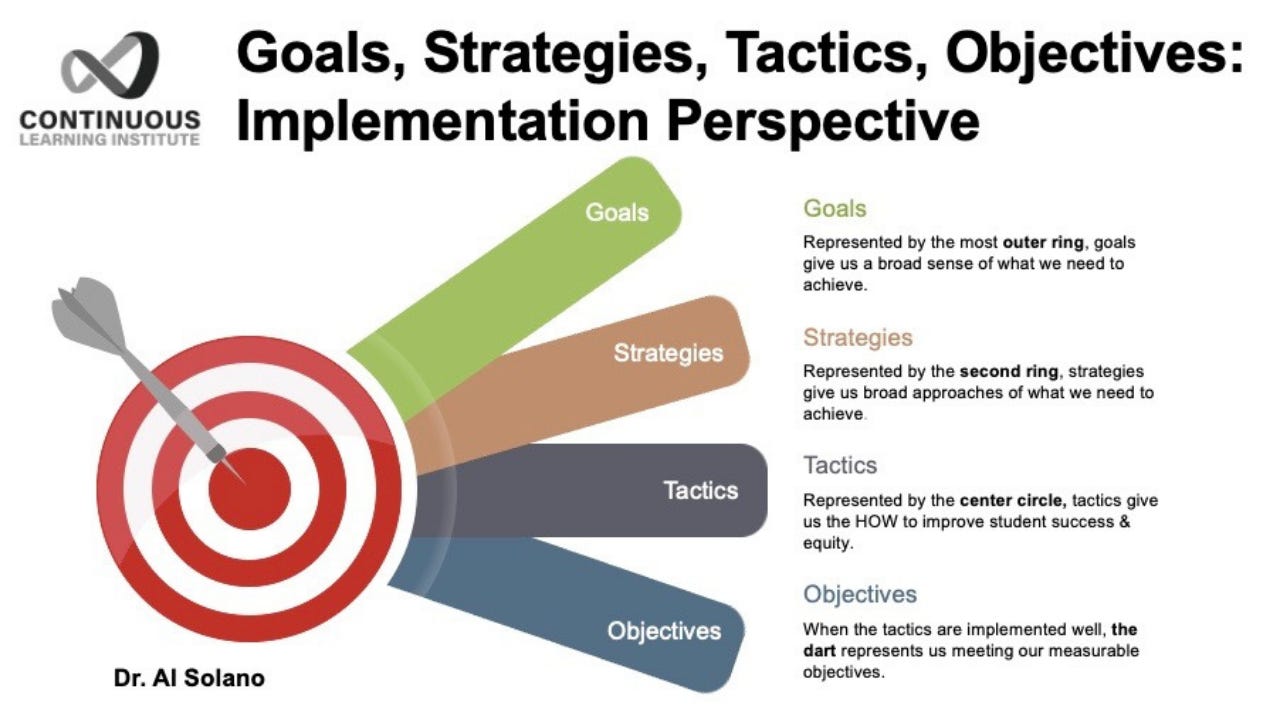
Outer Ring: GOALS
The “WHY” (Direction)
Broad outcomes aligned, for example, to a student journey.
Examples:
Improve Persistence and Completion
Strengthen Entry & Onboarding
Support Successful Transition
Key Idea:
Goals describe what must be achieved, not how.
Middle Ring: STRATEGIES
The “WHAT” (Approach)
High-level methods used to achieve the goals.
Examples:
Design programs to better align with living-wage jobs and transfer outcomes
Implement Student Success Teams
Create a Student-Centered Schedule
Expand Guided Onboarding
Integrate Culturally-Responsive Teaching Practices
Key Idea:
Strategies are durable. Ideally, they should survive leadership changes, funding shifts, and external shocks.
Inner Ring: TACTICS
The “HOW” (Action)
Specific, time-bound steps taken this year to implement strategies.
Examples:
Convene a design team by Fall
Small implementation of virtual success teams in X pathways
Train advisors on caseload practices
Train X faculty on active learning structures
Key Idea:
Tactics can change. They are owned, scheduled, and resourced.
The Dart, Bullseye: OBJECTIVES
The “RESULT” (Measurement)
Clear, measurable indicators that show whether strategies are working.
At too many campuses, objectives are written as either goals or strategies. I’m not suggesting upending all of the institution’s existing plans. When new plans are drawn up, it’s an opportunity to start fresh with clarity, especially when federal and state grants often consider objectives as measures.
Examples:
Reduce equity gaps in persistence by X% by [date]
Increase completion rates for Black and Latino students by X points by [date]
Reduce average time-to-completion by X terms by [date]
Increase students attaining a living-wage job by X% by [date]
Key Idea:
Objectives are not activities. They are evidence of impact. They’re also sometimes referred to as “KPIs,” key performance indicators.
Enhance your professional development. Continuous Learner subscription upgrade available.
More key insights with action steps.
Key Insight #1: Plans Fail When Language Is Inconsistent
When teams don’t share common definitions, they can’t move together.
At many colleges:
“Objectives” mean metrics in one plan and activities in another
“Strategies” are sometimes treated as goals
“Tactics” are buried or missing entirely
It may be a semantic debate, but it becomes an execution problem.
Action Step:
Limit the number of planning terms your institution uses and define them once, clearly, and consistently across:
Strategic plans
Enrollment plans
Ed Master plans
Grant proposals
Consistency reduces friction. Friction kills momentum.
Key Insight #2: Anchor Goals to the Student Journey
Goals should not be abstract aspirations. They should be grounded in how students actually move through the institution.
When colleges use a student journey framework, such as Guided Pathways or Completion by Design, goals naturally align to stages like:
Connection
Entry
Progress
Completion
Transition
This does two things:
It clarifies what must be achieved
It allows equity issues to be disaggregated at each journey point
Action Step:
Reframe institutional goals around the student journey rather than functional silos. If a goal cannot be clearly mapped to a point in the student experience, it likely lacks focus.
Key Insight #3: Strategies Are Approaches, Not Action Lists
A strategy is a broad method for achieving a goal, not a to-do list.
For example:
Implement student success teams is a strategy
Hold weekly meetings, assign caseloads, train faculty are tactics
When strategies are confused with tactics, plans become brittle and outdated the moment conditions change.
Action Step:
Pressure-test your strategies by asking:
Could this strategy still hold if conditions shift?
Does it describe how we’ll approach the work, not every step?
Good strategies are durable. Tactics are adaptable.
Key Insight #4: Objectives Are Measures, Not Activities
Objectives answer one question:
How will we know if the strategy is working?
They should be:
Measurable
Time-bound
Equity-aware
For example:
Closing a persistence equity gap by a defined percentage by a defined date
Objectives are about results, not effort.
Action Step:
Audit your objectives. If they describe something you do rather than something you measure, they are likely strategies or tactics in disguise.
Key Insight #5: Tactics Belong in Annual Implementation, Not the Plan
One of the most common misconceptions in higher education planning is that every tactic must be locked into a 5–10 year plan.
That’s a mistake. Plans should establish:
Goals
Strategies
Objectives
Tactics should be determined annually, based on real conditions, capacity, and context. Pandemics, funding shifts, leadership changes, etc., create changes in tactics. Plans must breathe.
Action Step:
Separate long-term plans from annual implementation cycles. Every plan should have 1-2 pages describing how the plan will be implemented.
Each year:
Select priority strategies
Define tactics
Assign responsibility
Set timelines
Execution lives in the present, not in an outdated appendix.
Key Insight #6: Simplicity Is a Leadership Move
I’ve seen plans that exceed 200 pages. With rare exceptions, no one reads them. And plans that aren’t read aren’t implemented.
Action Step:
Design plans for the people who must implement them. If a plan cannot be explained clearly in a short conversation, it is too complex to execute at scale.
The Bottom Line
Common language is not administrative housekeeping. It is a strategic lever.
When institutions:
Limit terminology
Define terms clearly
Align language across plans
Focus on implementation, not only documentation
They don’t just work harder. They work smarter. Simplicity and relentless clarity are how plans move from the pretty document to practice.
Reflection Questions
Where does your institution use the same planning term to mean different things?
Which parts of your plan describe action, and which describe outcomes?
What would change if your plan were written to be implemented, not just showcased?
Resource: Strategies: From Access to Completion
Need help with your plans? Contact me.
Depending on your college’s professional development policies, you may be reimbursed for the Continuous Learner premium subscription.
Use this template to request a reimbursement.
Let’s connect on LinkedIn.
Onward…
Dr. Al Solano
Founder, Continuous Learning Institute | About
Host, Student Success Podcast
A meaningful test of success is how helpful we are in contributing to our fellow human being’s happiness.
Adapted from Goals, Strategies, Tactics, and Objectives, Continuous Learning Institute
This hits on something huge that rarely gets discussed. The part about terms like objective meaning metrics in one plan and activities in another is exactly why so many strategic plans end up shelfware. At my last org we spent months building what looked like a solid plan only to realize halfway through that differnt departments had totally differnt definitions of success metrics.